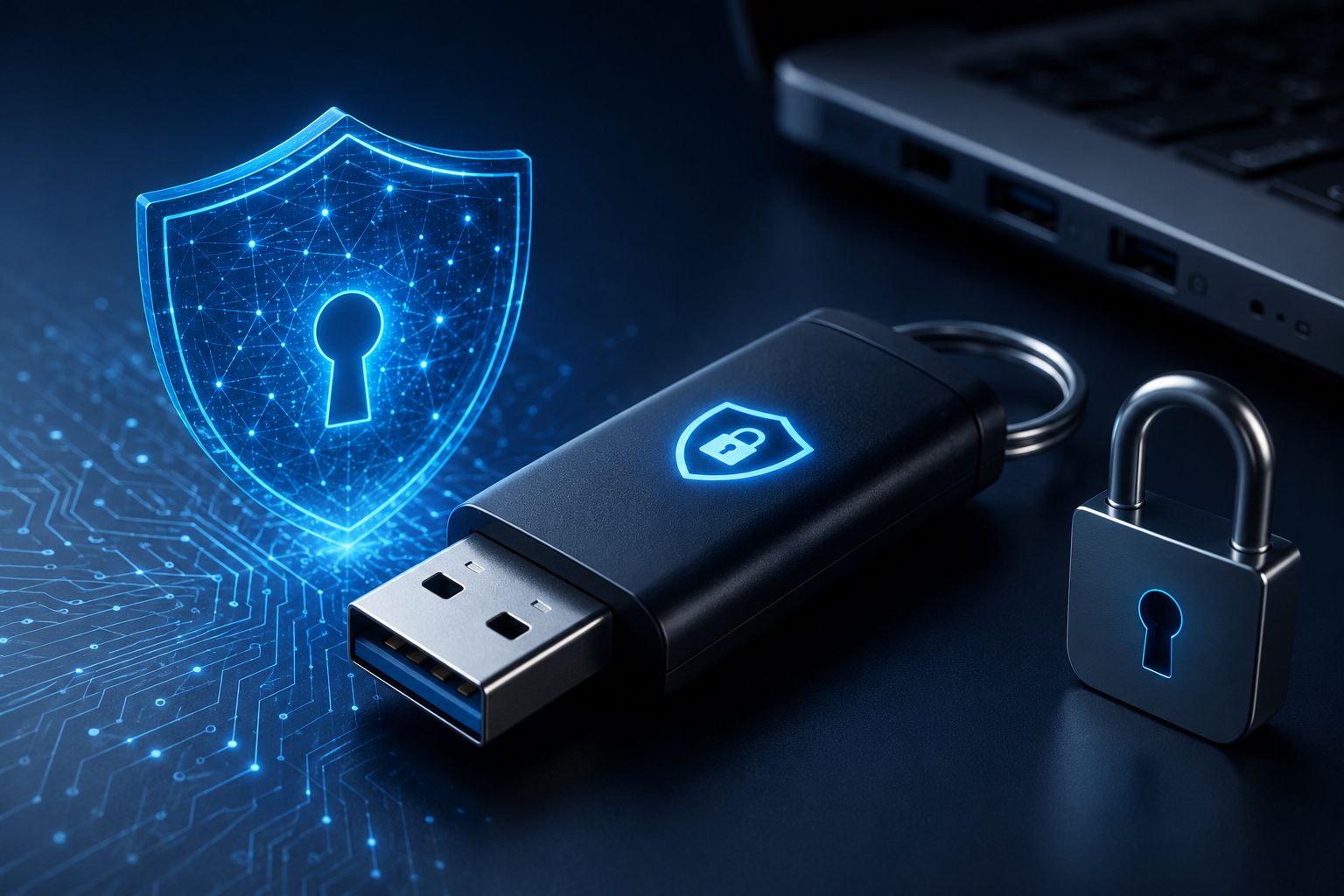
USB flash drives are incredibly convenient, but their security risks are often overlooked.
If your USB drive is lost or stolen, your personal files, photos, business documents, and sensitive information could be exposed instantly.
That's why encryption is no longer optional—it's essential.
In this guide, we'll compare:
- The most popular USB encryption solutions on the market
- Hardware encryption vs. file-level encryption
- Pros and cons of each approach
- The best options for different user needs
 Best USB Encryption Solutions in 2026
Hardware-Encrypted USB Drives
 Best Overall (Security + Ease of Use)
Key Features:
- Hardware-based AES-256 encryption
- Built-in PIN keypad
- Works independently of any computer or software
- Automatic encryption of all stored data
 Best for: Privacy-conscious individuals and business users.
 Best for Enterprise Security
Key Features:
- Enterprise-grade security certifications
- Brute-force attack protection
- Rugged and durable design
- Strong compliance capabilities
Best for: Corporate environments, IT departments, and regulated industries.
 Best Budget-Friendly Hardware Encryption
Key Features:
- AES-256 hardware encryption
- Multi-password support
- Brute-force attack protection
- Good balance of security and affordability
Best for: Individual users looking for affordable hardware encryption.
Software Encryption Solutions
Best Overall Software Solution (Security + Automation + Free)
Lumin (Mobile + File-Level Encryption)
Core Capabilities:
 Direct USB drive access from smartphones via OTG
 Unique encryption key for every file (file-level encryption)
 Automatic backup and automatic encryption
 View encrypted files directly without leaving decrypted copies on the device
 Free to use
Why It Ranks First
Lumin is more than just an encryption tool.
It combines:
- File backup
- File encryption
- Mobile accessibility
- Secure file management
into a single workflow.
Unlike traditional whole-drive encryption, file-level encryption reduces single-point-of-failure risks and provides more granular protection.
Best for:
- Mobile users
- Privacy-focused individuals
- Users who want security without complicated setup
- Anyone seeking automatic encrypted backups
Among today's solutions, it is one of the few that combines automation, file-level encryption, and mobile support.
Best High-Security Option for Technical Users
Key Features:
- Strong encryption algorithms (AES, Serpent, Twofish)
- Encrypted containers and volume encryption
- Open-source and widely trusted
- Highly configurable
Limitations:
 Steep learning curve
- Not beginner-friendly
Best for:
- Security professionals
- Technical users
- Advanced privacy enthusiasts
Traditional Encryption Software
Gilisoft / UkeySoft and Similar Tools
Key Features:
- Partition encryption
- Simple setup
- Affordable pricing
Limitations:
- Primarily based on partition or full-drive encryption
- Creates a single point of failure
If the password is compromised, all protected data may become accessible.
Best for:
- Casual users needing basic protection
Lightweight Encryption Tools
Key Features:
- Portable and lightweight
- Suitable for temporary file encryption
- Easy to use
Limitations:
- Not ideal for long-term data protection
- Lacks a comprehensive security framework
Best for:
- Temporary file sharing
- Occasional encryption needs
 Feature Comparison
| Feature | Lumin | VeraCrypt | Gilisoft-Type Tools | Lightweight Tools |
|---|---|---|---|---|
| Encryption Method | File-Level (Per-File) | Container-Based | Partition/Full-Disk | File-Level |
| Automation |  |
 |
|
|
| Free Version | |
|
|
|
| Ease of Use |  |
|
|
|
| Security Architecture | Distributed Risk | Moderate | Single Point of Failure | Moderate |
 Hardware Encryption vs. Software Encryption
Advantages of Hardware Encryption
- Encryption happens automatically
- Data is encrypted as soon as it is written
- Less dependent on operating systems
- Generally more resistant to attacks
Drawbacks
- Higher cost
- Limited flexibility
- Hardware failure may affect data accessibility
 Advantages of Software Encryption
- Lower cost
- Flexible deployment
- Supports various encryption models
- Easier to update and manage
Drawbacks
- Depends on the operating system
- Security may be affected by malware or system vulnerabilities
- User configuration errors are more common
 Common Security Mistakes
Many users mistakenly believe:
"My USB drive is safe as long as I don't lose it."
"A simple password is good enough."
"Built-in operating system protection is sufficient."
These assumptions often lead to data leaks and security incidents.
 Which Encryption Method Is the Safest?
A useful way to think about it:
Whole-drive encryption = Single point of failure
If access is gained, all files become available.
File-level encryption = Distributed protection
Each file is encrypted individually, reducing overall risk and improving compartmentalization.
Recommendations
- Maximum security → File-level encryption
- Maximum convenience → Hardware-encrypted USB drives
- Lowest cost and greatest flexibility → Software encryption
 Final Verdict
Hardware Encryption
 Plug-and-play convenience
Strong security
Reliable for everyday use
Software Encryption
Cost-effective
Flexible and versatile
Suitable for most users
File-Level Encryption
Strongest security architecture
Reduced single-point-of-failure risk
Ideal for privacy-sensitive data
For users who prioritize data protection, file-level encryption offers the most comprehensive security model available today.