File sharing and cloud synchronization are often treated as interchangeable.
In practice, they solve different problems, rely on different assumptions, and introduce different trade-offs.
Understanding the distinction matters—not because one approach is universally better, but because confusing the two often leads to unintended consequences around privacy, control, and long-term access.
This article explains why file sharing and cloud sync are fundamentally not the same thing.
How File Sharing Was Originally Defined
At its core, file sharing answers a simple question:
How can I send a file from one device to another?
Traditional file sharing focused on:
-
A specific sender
-
A specific recipient
-
A defined moment in time
Once the transfer was complete, the relationship ended.
There was no expectation of persistence, synchronization, or ongoing access.
What Cloud Sync Is Designed to Do
Cloud synchronization solves a different problem:
How can the same files stay consistent across multiple devices over time?
To achieve this, cloud sync systems typically require:
-
A central storage service
-
Persistent user accounts
-
Continuous background processes
Files are not merely transferred—they are replicated, monitored, and reconciled across devices.
This distinction is subtle but critical.
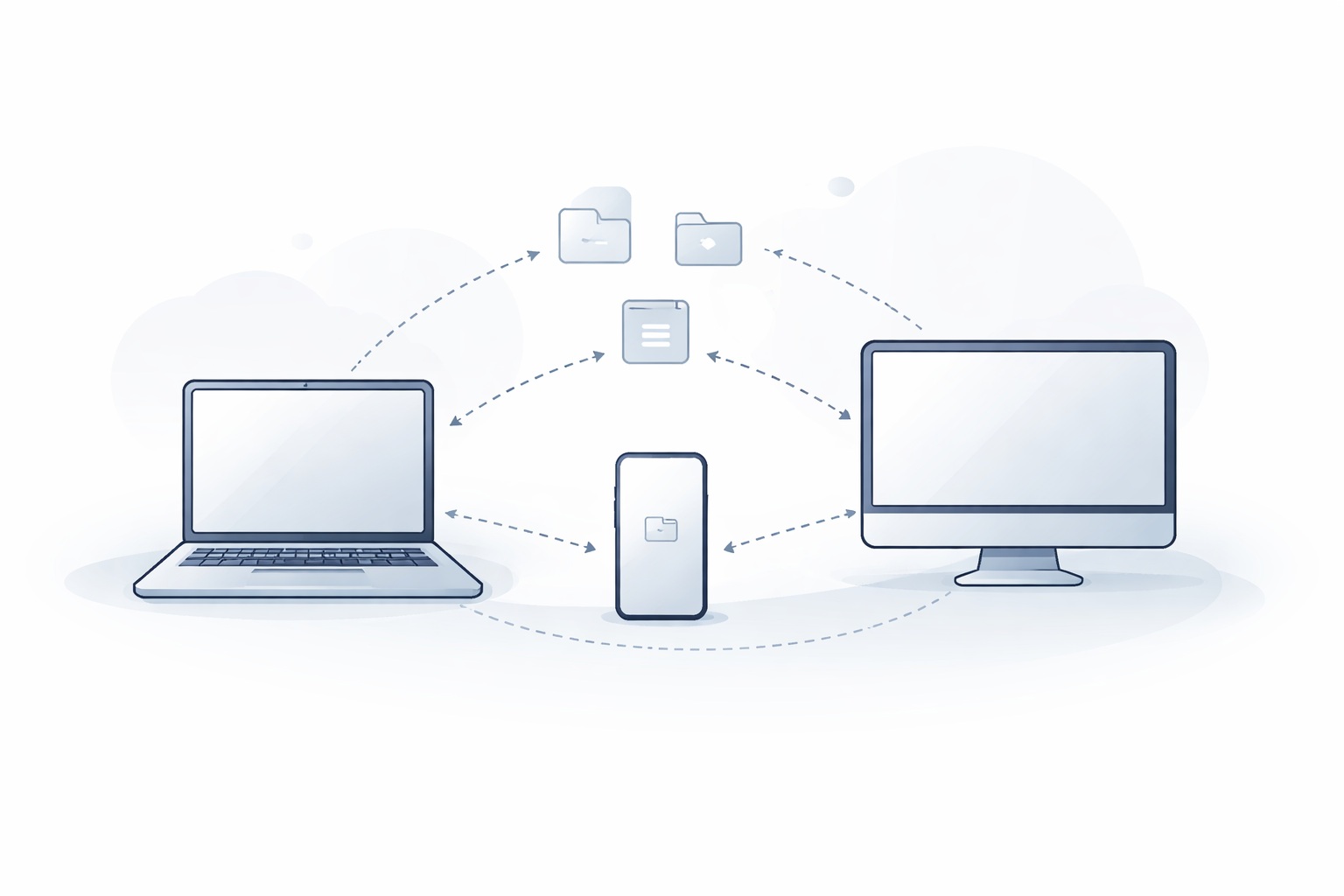
Transfer vs Synchronization
The difference can be summarized simply:
-
File sharing is event-based
-
Cloud sync is state-based
File sharing moves a file from point A to point B.
Cloud sync maintains a shared state across multiple endpoints.
When file sharing is implemented using cloud sync infrastructure, the transfer becomes only a side effect of a larger system designed for persistence.
Why the Confusion Became Common
Several factors contributed to the blurred boundary:
-
Cloud services marketed “sharing links” as file sharing
-
User accounts became the default access mechanism
-
Convenience replaced intentional transfer
As a result, many users now “share” files by uploading them indefinitely and granting ongoing access, even when temporary delivery would suffice.
Structural Differences That Matter
Although both approaches may appear similar on the surface, their structures differ significantly.
File sharing typically assumes:
-
Temporary access
-
Minimal third-party involvement
-
Clear sender–receiver boundaries
Cloud sync typically assumes:
-
Persistent storage
-
Ongoing access management
-
Trust in a centralized service
These assumptions affect privacy expectations, data retention, and failure scenarios.
The Privacy Implications
When a file is shared via cloud sync:
-
Copies often remain stored long after delivery
-
Access permissions may persist indefinitely
-
Metadata about files and interactions accumulates over time
File sharing, when treated as a discrete transfer, limits exposure by design.
The issue is not encryption alone, but how long data remains accessible and to whom.
When Cloud Sync Is the Right Tool
Cloud synchronization is highly effective when:
-
Multiple devices need constant access to the same files
-
Long-term consistency matters more than transfer control
-
Collaboration is continuous and multi-directional
In these scenarios, treating files as a shared state makes sense.
The problem arises when cloud sync is used by default for one-time or short-lived transfers.
Why This Distinction Matters in Practice
Failing to distinguish file sharing from cloud sync often leads to:
-
Overexposure of personal data
-
Unnecessary account dependencies
-
Confusion about where files actually reside
Understanding the difference allows users to choose tools and workflows that match their actual needs rather than default behaviors.
How This Relates to Local-first Approaches
Local-first file sharing deliberately preserves the original intent of file sharing:
-
Files originate on user devices
-
Transfers are intentional and bounded
-
Persistence is a choice, not a default
This approach does not reject the cloud outright, but redefines its role.
For a broader architectural view, see:
→ Local-first File Sharing & Private Storage: A Practical Guide
Summary
File sharing and cloud sync address different use cases:
-
File sharing delivers files
-
Cloud sync maintains shared states
Treating them as interchangeable simplifies user experience but obscures important trade-offs around control, privacy, and data longevity.
Recognizing the difference is the first step toward choosing workflows that align with actual intent rather than inherited defaults.